Pawn shops, jewellery stores and cash-for-gold businesses all depend on the precise techniques of identifying whether something is actual gold or an alloy of metals. Along with determining authenticity, it is also necessary to determine the percentage of precious metal material in order to determine its value.
The mere visual observation cannot be used to identify the precise composition or purity of a metal object. To get accurate results, dependable methods of analysis are needed.
Fire assay is generally considered the most reliable technique of examining gold, and is also considered the standard process of legal hallmarking. Nevertheless, this is a destructive method, in that it entails the melting of the sample, to determine the concentration of gold or other metals.
Another method that has become a common practice in jewellery stores, pawn shops, and the like is portable X-ray fluorescence (XRF). Precious metal XRF analysers enable users to easily identify the composition of precious metals such as gold. Besides determining the amount of gold in an item, the method can also identify and quantify fringe elements, alloys and possible harmful heavy metals which might be of interest in health factors as well as in the overall value of the item. The major benefit of the XRF is that it is non-destructive, implying that the item is not destroyed and still has value after testing. This is more so when handling high value pieces.
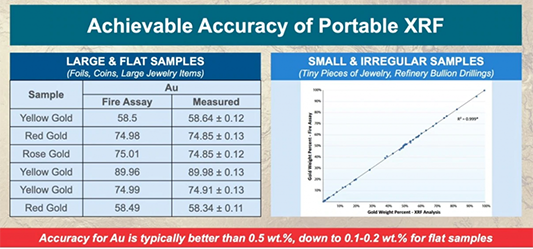
An experiment was done to compare the results of portable XRF to the results of fire assay in order to assess its reliability. Six large, flat samples constructed of the various kinds of gold, of diverse grades and compositions were experimented with. Its findings revealed that XRF values were typically within 0.1 or 0.2% of the values of fire assay.
More testing was done on smaller samples, which were irregularly shaped. The accuracy observed in such instances was within the 0.5 weight percent of the fire assay. A summary chart was developed to show the results of the various samples.
Certain limitations are to be taken into account. Gold filled jewellery, gold bars and bullion should not be analysed using portable XRF. In such cases its application should be accompanied by a secondary verification procedure to verify that there is no thick surface plating or material alteration which may influence the results.
Source: Thermo Fisher Scientific – Analyzing Metals
Blog Source: https://www.nitonuk.co.uk/how-accurate-is-portable-xrf-compared-to-fire-assay-for-gold-analysis/



There are no comments yet!