
Non-Destructive Testing (NDT) stands as one of the most vital disciplines in modern engineering. It safeguards infrastructure, machinery, and human life without causing any damage to the materials being tested. Yet, behind the technology and instruments, there is a human story — the journey of the NDT technician. This journey, often unseen, involves years of training, practice, and certification that gradually shape a beginner into an expert capable of ensuring the integrity of complex systems. According to the American Society for Nondestructive Testing (ASNT) Recommended Practice SNT-TC-1A, NDT personnel are classified into three key levels: Level I, Level II, and Level III. Each level represents a stage of technical maturity, responsibility, and professional trust.
Level I – The Foundation Stage
The NDT career begins with Level I — the entry-level stage where technicians learn the fundamentals of inspection. At this level, an individual performs specific calibrations, tests, and evaluations according to written instructions and under direct supervision from Level II or Level III personnel. Level I technicians are not authorized to interpret results or make accept/reject decisions. Instead, their primary responsibility lies in accurate data collection and adherence to established procedures.
Under SNT-TC-1A, Level I personnel are required to complete both classroom training and a defined number of practical experience hours, which vary depending on the testing method. For example, in Ultrasonic Testing (UT), ASNT recommends approximately 40 hours of formal training and up to 210 hours of experience before certification. This ensures that even the newest technician develops a strong grasp of the equipment, materials, and basic defect recognition.
The Level I phase is where discipline and consistency are built. Tasks such as equipment setup, basic calibration, and handling of test specimens may appear repetitive, but they form the foundation for accuracy and confidence. Every reading, signal, and trace captured by a Level I technician contributes to the integrity of the final evaluation.
Level II – The Professional Stage
Once the fundamentals are mastered, the technician progresses to Level II — a stage that demands both technical competence and analytical thinking. A Level II technician can set up and calibrate equipment independently, conduct tests, interpret results, and make accept/reject decisions according to applicable standards and specifications. They may also be responsible for preparing written instructions for Level I personnel and providing on-the-job training.
According to ASNT SNT-TC-1A, the requirements for Level II certification are more extensive. For instance, in Magnetic Particle Testing (MT) or Liquid Penetrant Testing (PT), a technician must complete 16–24 hours of formal training and accumulate 400–530 hours of hands-on experience. In more complex techniques such as Ultrasonic or Radiographic Testing, the required experience often exceeds 800–1,200 hours. These standards ensure that a Level II technician has both theoretical depth and practical versatility.
At this level, technicians are expected to understand the physics of wave propagation, radiation safety, material properties, and defect mechanisms. Their decisions directly affect production schedules, quality assurance, and safety outcomes. They serve as the operational backbone of most inspection programs — balancing precision with productivity. In addition, Level II personnel often mentor Level I technicians, cultivating the next generation of skilled inspectors.
Visual Comparison: Training and Experience Requirements
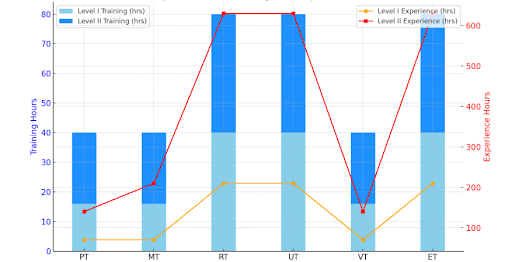
Figure 1. Dual-axis chart: Required initial training & experience levels
Figure 1 illustrates the required training and experience hours for various testing methods (PT, MT, RT, UT, VT, ET) as outlined in SNT-TC-1A . The blue bars represent the formal training required at each level, while the orange and red lines depict the corresponding experience hours for Levels I and II respectively.
This visual clearly demonstrates how experience demands grow exponentially between certification levels, particularly in Radiographic and Ultrasonic Testing, where both theoretical knowledge and practical exposure are critical to ensuring inspection accuracy and safety compliance.
Level III – The Expert and Mentor
Level III represents the pinnacle of NDT certification — the expert, consultant, and mentor. A Level III individual possesses advanced knowledge of testing principles, materials science, codes, and industry standards. They are responsible for developing, qualifying, and approving NDT procedures, interpreting codes and specifications, and ensuring compliance with client and regulatory requirements.
Under SNT-TC-1A, Level III certification involves rigorous theoretical training and significant experience — often several years in the field across multiple NDT methods. Level III personnel must demonstrate not only technical mastery but also leadership, communication, and auditing capabilities. They are authorized to conduct examinations, train and certify Level I and Level II technicians, and serve as the ultimate authority on inspection-related decisions.
The Level III technician’s role extends beyond technical supervision. They influence company policy, quality assurance systems, and long-term training programs. They often collaborate with engineers, project managers, and regulatory agencies to align testing practices with industry standards such as ASME, ASTM, and ISO 9712. Their decisions can determine the safety of pressure vessels, pipelines, aircraft structures, and nuclear components — underscoring the immense responsibility they carry.
A Global Perspective on NDT Certification:
While the ASNT SNT-TC-1A framework is the most widely adopted in North America, several other international certification systems govern NDT qualification and competency worldwide. In Europe and many parts of Asia, the ISO 9712 standard—administered by accredited bodies such as BINDT (UK), and AINDT (Australia)—is the recognized system. Unlike ASNT’s employer-based certification, ISO 9712 follows a central certification model, where independent third-party bodies conduct examinations and issue credentials valid across participating nations. This provides harmonization and mobility for technicians seeking international employment.
Similarly, the Canadian General Standards Board (CGSB) oversees NDT certification in Canada under the CAN/CGSB-48.9712 program, aligning closely with ISO 9712 principles. In Japan, the Japanese Society for Non-Destructive Inspection (JSNDI) administers national-level certifications, while India follows a hybrid system through ISNT (Indian Society for Non-Destructive Testing), offering both employer-based (SNT-TC-1A) and central certifications (ISO 9712). Despite regional variations, all systems share the same core objective — to ensure that NDT professionals possess the technical knowledge, practical competence, and ethical accountability required to safeguard infrastructure and public safety. ASNT is also not going towards hybrid system.
Continuous Learning and Certification Maintenance
The NDT field evolves rapidly with advances in digital imaging, automation, and data analysis. Therefore, certification is not a one-time achievement but a continuous commitment to learning. Technicians must stay current with new methods, such as Phased Array Ultrasonic Testing (PAUT), Digital Radiography (DR), and Acoustic Emission Testing (AE). ASNT SNT-TC-1A encourages employers to establish periodic requalification and recertification processes, ensuring ongoing competence and safety.
In addition, many technicians pursue multi-method certifications to expand career opportunities. This versatility makes them valuable assets to industries like aerospace, oil and gas, power generation, and manufacturing. Employers increasingly look for personnel who not only possess certifications but also demonstrate problem-solving skills, data interpretation accuracy, and ethical integrity.
The Human Side of NDT
Behind every test result is a professional who understands that safety depends on their precision. NDT technicians often work under demanding conditions — in confined spaces, high elevations, or hazardous environments — where concentration and accountability are critical. Their job requires more than technical expertise; it demands judgment, patience, and unwavering integrity.
The unseen journey of an NDT technician is therefore a story of growth, mentorship, and responsibility. From the first day of training to the moment they become a trusted Level III, these professionals embody the spirit of reliability that defines engineering excellence. They are the silent guardians ensuring that bridges stand, aircraft fly, and industries operate safely — all without leaving a single visible mark.
In essence, the ASNT SNT-TC-1A framework not only defines the hierarchy of skills and responsibilities but also symbolizes the path of lifelong learning in NDT. Each level builds upon the previous one, creating a structured yet deeply personal evolution — from following instructions to writing them, from performing tests to shaping standards. The unseen journey of NDT technicians is not just about finding flaws in materials but about achieving perfection in practice, character, and commitment.
Author: Vineet Yadav & Kuldeep Sharma




There are no comments yet!