
The world's most critical infrastructure is currently entering a new era of infrastructure management. Asset owners and engineers face the immense challenge of managing assets that are approaching or exceeding their original design lifespan.
In Europe and the US, 4 million bridges are now over 50 years old. In the UK alone, over 3,500 bridges have surpassed their anticipated service life, creating an escalating need for highly reliable inspection data to guide maintenance and capital expenditure.
The core obstacle has long been the inability to obtain clear measurements of a structure’s deep internal condition. While established NDT methods are indispensable for routine inspection, they often share a practical limitation: they cannot effectively penetrate and deeply image the core of massive structures, particularly those reinforced with layers of steel, leaving integrity assessments reliant on extrapolated surface data.
The current situation often leads to a 4x investment overspend, 2x deficient maintenance, and 5x excessive CO2 emissions due to suboptimal planning and reactive repairs.
This leaves owners facing tough choices: either accept unknown risk, commit to possible costly over-remediation based on limited information, or embrace advanced technologies to pinpoint exactly where repairs are needed.
GScan is directly addressing this challenge by developing and deploying muon tomography (MT). This non-invasive technology harnesses natural cosmic muons and advanced Artificial Intelligence (AI) to provide high-resolution 3D imaging and accurate condition data on hidden critical elements buried deep within our infrastructure
This approach is not a replacement for traditional NDT methods; it is a vital, necessary extension, offering the missing volumetric data required for informed, predictive life-cycle management. With muon tomography, it’s possible to start putting more trust into the data of existing structures. Volumetric inspection enables:
- Spatially known locations
- More accurate deterioration models
- Reduced safety risks
Cosmic insights for aging infrastructure management
While muon tomography is not a new technology, with its first ever application taking place in 1955 by Eric George, it has only been in the past decade where it has been applied to structures, and the results have been transformational for the industry.
Key recent milestones for the technology include the successful deployment in a trial to detect wire breaks in suspension bridge cables, the first deployment of MT on an operational post tension bridge in the UK, and the first half joint inspected with MT, all taking place in 2025.
Muons are subatomic particles that are born when cosmic rays hit the Earth’s atmosphere. They move at nearly the speed of light, penetrate everything and are completely harmless to humans (and animals). Unlike artificially generated X-rays or gamma rays, muons possess the energy and mass required to traverse great depths.
How it works
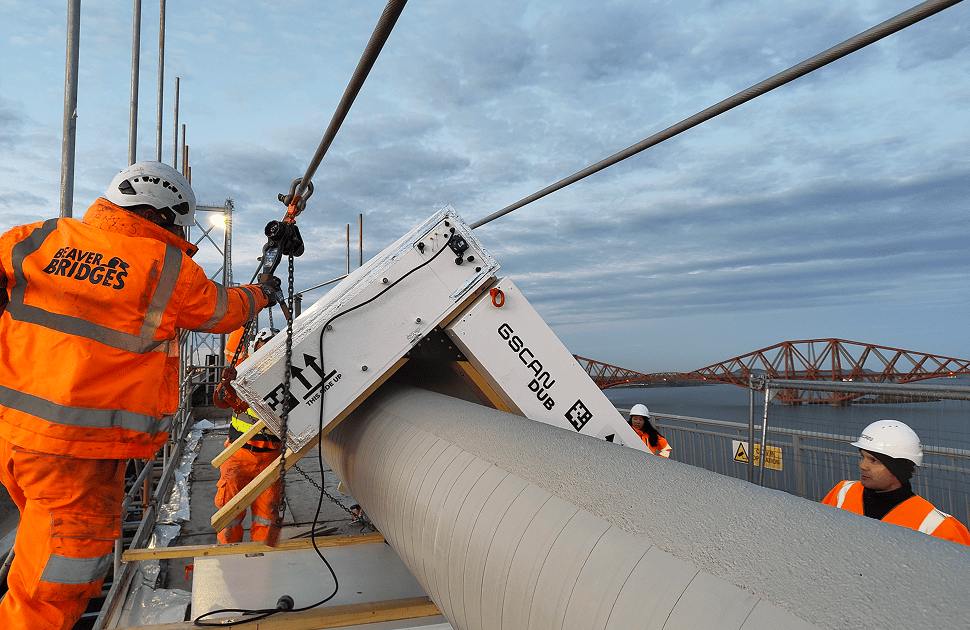
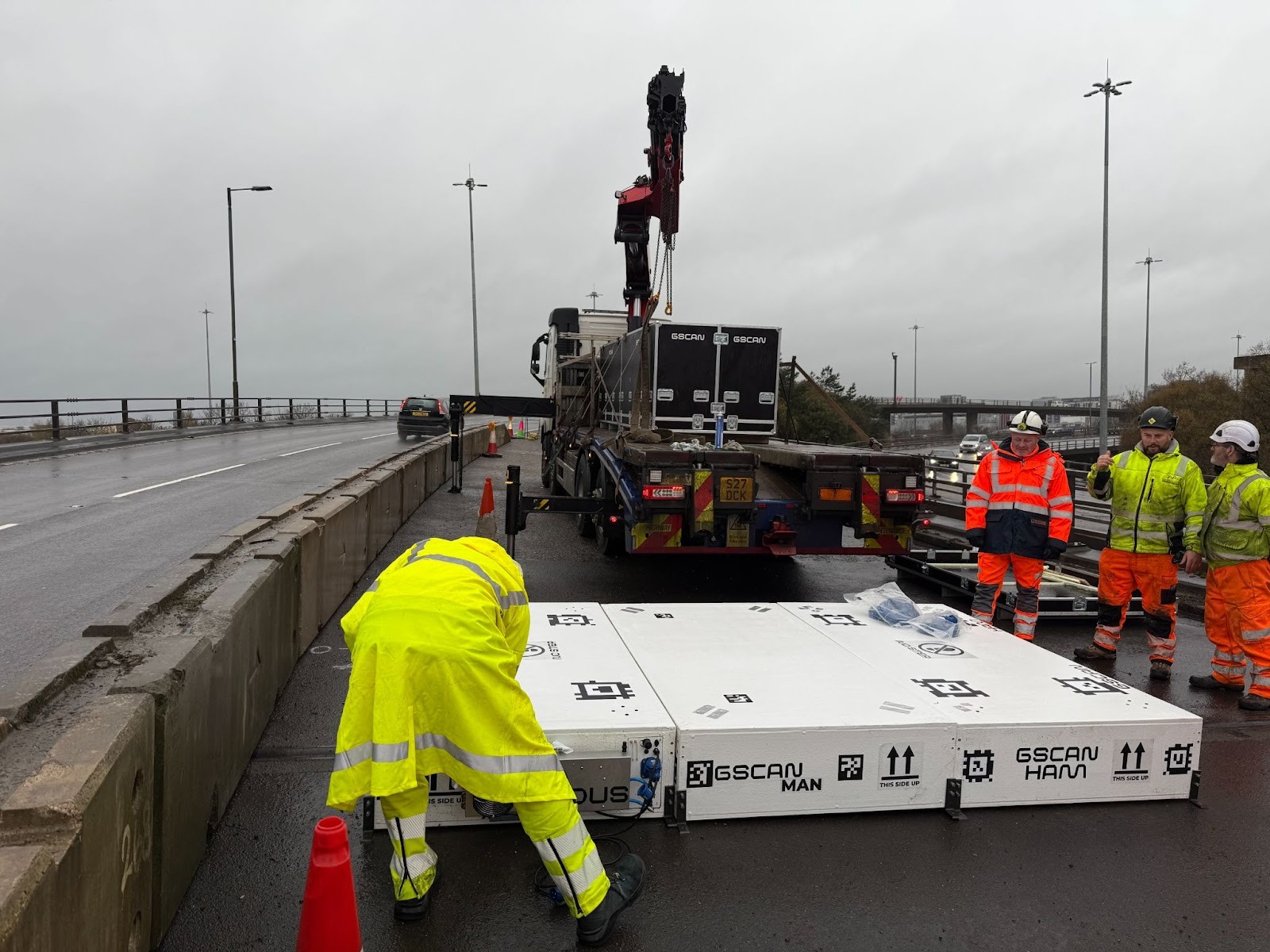
Gscan’s system involves the deployment of specialized Muon Flux scanners placed at strategic points on the structure. The scanners precisely measure the incoming and outgoing paths (trajectories) of millions of muons over time. By mathematically reconstructing the scattering patterns, the system generates a high-resolution imaging of the structure’s internal components.
The technology is able to:
- Penetrate deep into reinforced structures, providing detailed 3D images of hidden elements.
- Detect structural issues such as voids, section loss and breaks in the tendons
- Establish reinforcement and post-tension details when original records have been lost - a frequent and critical problem with aging assets.
Actionable Intelligence for Critical Infrastructure Management
An important question for asset owners is, "What’s hidden inside our structures?" Critical defects can progress largely undetected, while a structure that appears deteriorated on the outside can sometimes be in pristine condition inside.
Muon Flux Technology directly answers this important question with its unique ability to resolve structural issues previously deemed un-inspectable, effectively making the invisible visible.
The technology’s utility extends beyond reinforced concrete assessment; it is also a powerful tool for evaluating the technical condition and internal geometry of steel structures.
Detecting tendon breaks and section Loss
Corrosion remains the primary concern for reinforced concrete. Crucially, conventional methods often fail to accurately assess the extent of corrosion-induced steel loss deep within the cross-section.
MFT can detect damage to internal structures and changes in chemical composition induced by carbonation, chloride ingress, and corrosion. The system provides an empirical measure of the remaining steel cross-sectional area with 3mm accuracy.
Assuring Grout and Void Integrity in Vulnerable Areas
Integrity assessment of post-tensioning ducts, anchors, and deep foundations is paramount. Voids within grouted tendons can compromise load transfer and invite accelerated corrosion. With millions of bridges now over 50 years old, areas like half joints present a significant risk. These vulnerable components have historically been challenging to inspect.
As the only technology that is capable of "seeing" inside complex areas like half joints, MFT is proving to be a crucial step forward. The system accurately locates and quantifies the precise coordinates and volume of voids or poor consolidation. This delivers the accurate measurement-based information on the condition of the half joint re-entrant corner, reinforcement, and anchor points necessary to:
- Avoid unnecessary demolition
- Safely reduce repair budgets
- Preserve vital infrastructure
This enables surgical repair strategies: identifying the exact location and geometry of the void allows maintenance teams to perform precise, targeted repairs, drastically reducing the cost and invasiveness associated with exploratory drilling or mass repairs.
Monitoring Long-Term Material Changes
For long-life, sustainable assets, the ability to track structural health over time is essential. By establishing a diagnostic baseline, repeated muon scans allow engineers to track the progression of density variations over time. This provides quantitative data necessary for forward-looking asset management, allowing assets to be managed based on their actual rate of deterioration rather than generic service life estimates.
AI-powered analysis and 3D reconstruction of data
The sheer volume of data generated by millions of muons necessitates advanced computational processing. This is where the integration of Artificial Intelligence (AI) and Machine Learning (ML) help to bring a new level of analysis.
MFT, which was developed in 2018 with the dedication of the GScan founders and development team in Estonia, combines state-of-the-art scanners with AI-enabled software.
The AI/ML components perform several critical functions:
- AI enables the capability to analyse and classify many different materials with machine learning-based 3D modelling tools for advanced reconstruction.
- For analysis of object detection results, GScan developed ML algorithms that detect different materials based on the scattering histogram pattern and this layer is mainly used to point out the desired elements and their location.
- To detect anomalies inside the duct, the system uses scattering-based algorithms that clearly reveal the location of missing grouting.
The unified reconstruction and AI-assisted classification deliver faster turnaround from acquisition to interpretable 3D outputs and actionable decision-making.
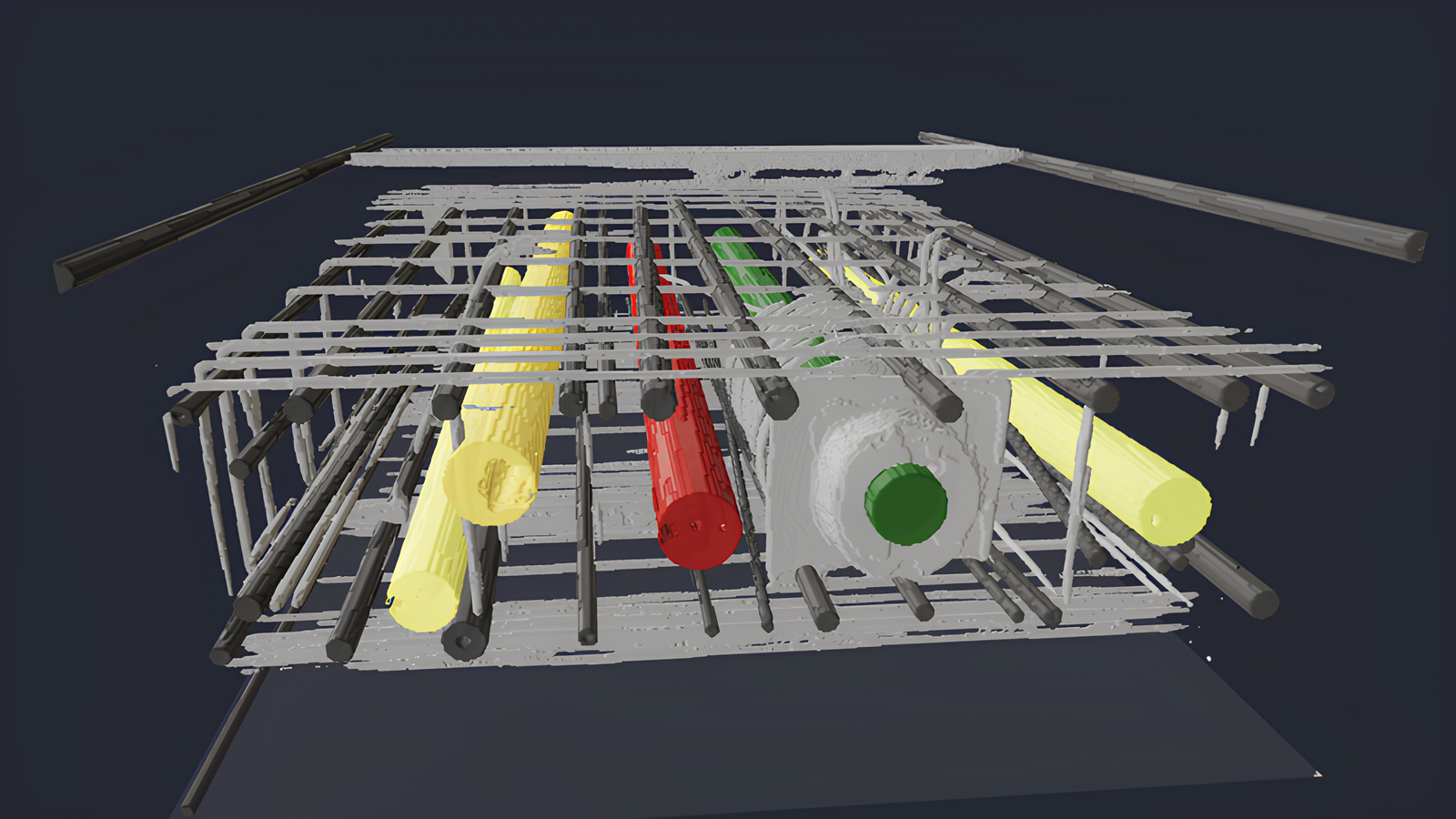
Together with the explicitly planned multi-view tomography, the technology provides true volumetric (3D) models tied to site coordinates, with deliverables formatted for CAD/BIM/GIS integration.
Operational Benefits and Future Applications
For asset managers, MFT offers distinct operational advantages:
- Safety profile: By utilising natural cosmic rays, the system eliminates the need for exclusion zones, specialised radiation permits, or safety officers required for artificial radiation sources, enhancing site safety and streamlining deployment.
- Environmental Impact: Having focused on the scalability, reliability and a small carbon footprint throughout the development, GScan’s MFT systems are energy-efficient and produce no hazardous waste throughout their lifespan, nor after it - ensuring steps towards a cleaner, safer and more sustainable future.
- Deployment: GScan’s MFT System is built for smooth fieldwork. Measurements are immune to external factors like moisture, material thickness, or inspector skill. It also requires minimal operational training.
Gscan’s technology has been strategically deployed in several ground-breaking projects, including the National Highways Structures Moonshot programme, which helped to develop the technology.
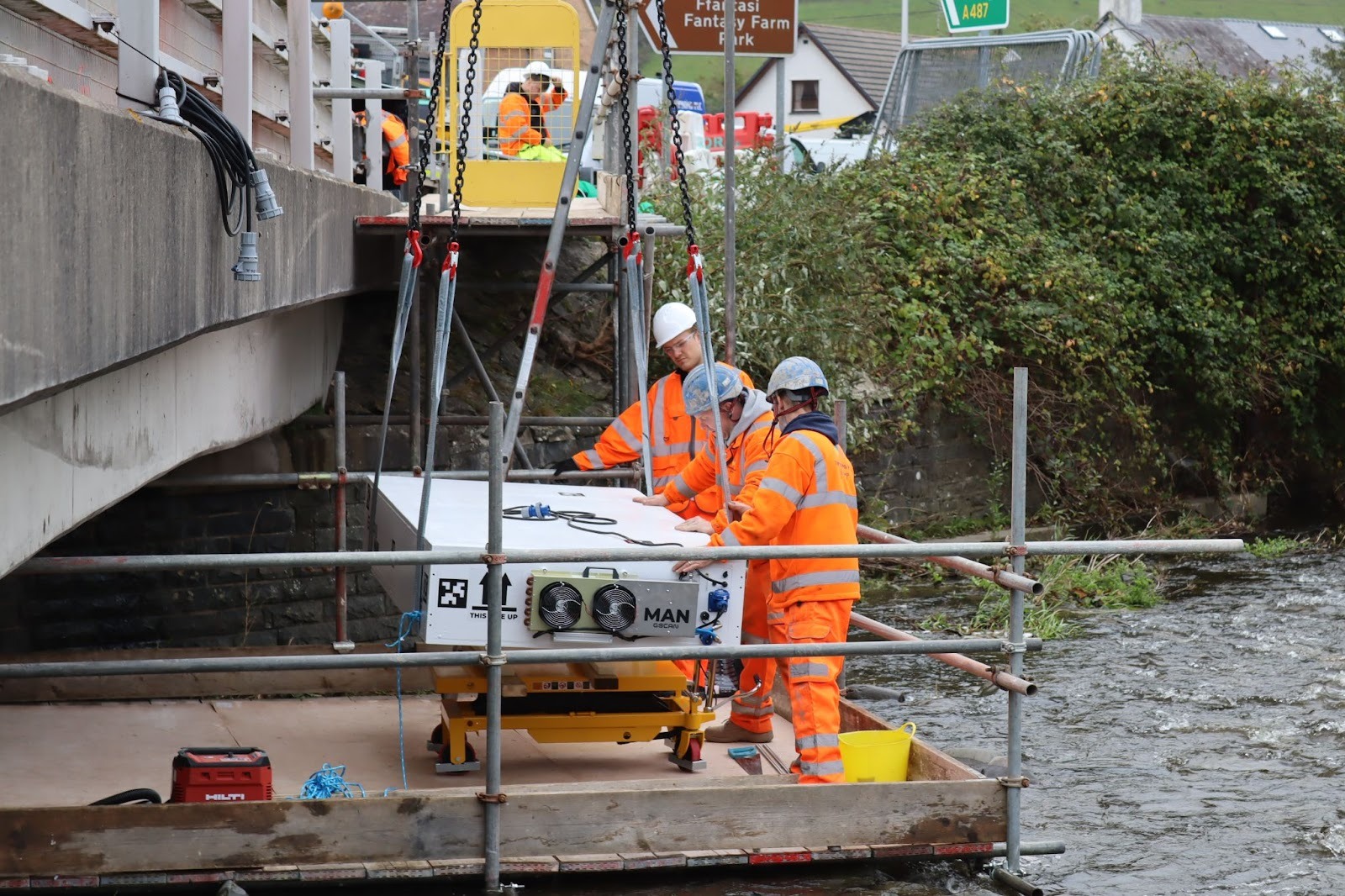
MFT was specified by Gwynedd Consultancy (YGC) on an in-service Post Tensioned Bridge on the Welsh Trunk Road Network. Construction information was limited, which was required to carry out a strength assessment. Significant NDT and intrusive work had already been carried out on the bridge, but this had not been able to find deeply buried tendons. GPR techniques had been unsuccessful, as the shallow steel reinforcement in the deck soffit masked the location of the deeply placed PT ducts and a foil backed waterproofing layer on the top of the bridge deck was impenetrable to GPR.
Principal Engineer for YGC, Bob Humphreys, said “We are very pleased with the results GScan have provided; the MFT successfully located all PT apparatus and steel reinforcement in the area scanned. We are now in a much better position to manage the structure.”
The technology is rapidly gaining demand all over the globe with scheduled works in the UK, Japan, Germany, Netherlands, France, Switzerland and Estonia. By providing accurate, volumetric, and non-invasive data on the internal condition of massive structures, GScan is enabling a new standard of infrastructure management.
Organisations that embrace this data-driven asset management are achieving substantial reductions in maintenance costs while improving asset reliability. The technology is leading directly to reduced operational risk, optimised maintenance budgets, and the maximum safe extension of critical asset life.
Want to know more about Muon Flux Technology? Visit www.GScan.eu
There are no comments yet!