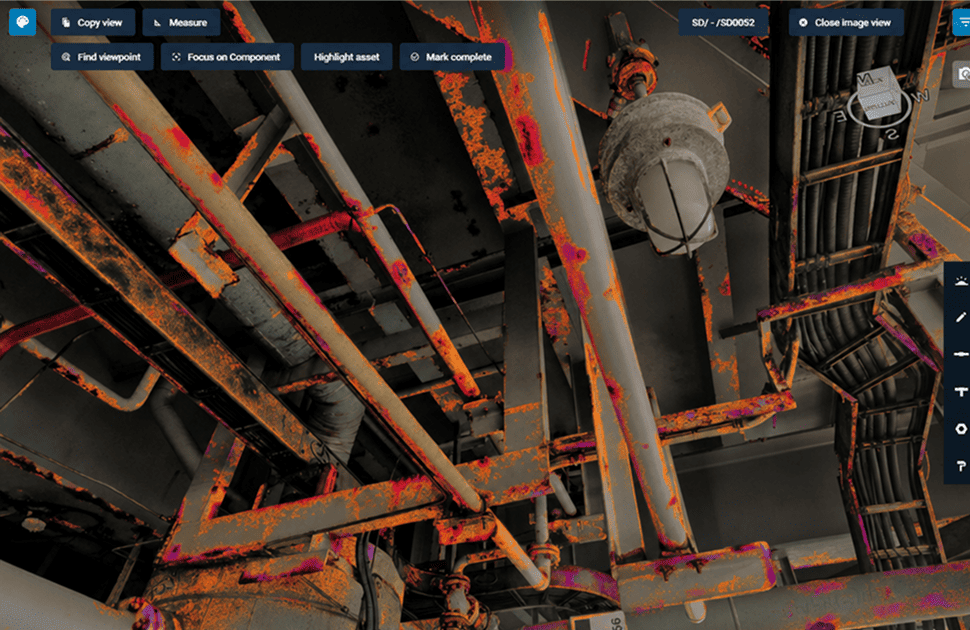
In 2026, the global asset integrity and Non-Destructive Testing (NDT) industries are experiencing a significant technological transformation driven by Artificial Intelligence and digital twin infrastructure. Conventional manual inspections are swiftly being replaced by autonomous data capture systems that utilize computer vision to remove human bias, significantly lower operational expenses, and improve site safety. The global predictive maintenance market is witnessing explosive and consistent growth. This impressive economic expansion is propelled by the industry's urgent need to minimize equipment downtime and refine maintenance scheduling, which leads to substantial savings on operational costs. With stricter regulations and a growing focus on safety being reinforced each year, continued investment and expansion in such technology is to be expected. Abyss Solutions is at the forefront of this change in the energy sector with Abyss Fabric, a comprehensive digital inspection platform powered by AI.
Company Profile: Pioneering Autonomous Inspections at Scale
Abyss Solutions is a pioneer in autonomous inspection. With industry 4.0 well underway, Abyss provides the software solution that allows autonomous robots to acquire, process, and analyze data on a large scale.
The foundational purpose of Abyss is rooted in sustainability: to protect and conserve the world's most valuable resources for generations to come. By actively preventing Loss of Primary Containment (LOPC) events and reducing the necessity for fuel consumption, such as offshore helicopter flights, Abyss actively assists multinational corporations in exceeding their health, safety, and decarbonization targets. The overarching corporate vision is to pioneer autonomous systems to enable structural inspections at an enterprise scale.
We are headquartered in Houston, Texas, which is the epicenter for our interactions with the global oil and gas industry. To support its rapidly expanding international clientele, Abyss maintains dedicated regional offices in the United Kingdom, Australia, Brazil, Pakistan, and the United Arab Emirates. A critical market differentiator at Abyss is our world-class Research and Development (R&D) center located in Sydney, Australia. The R&D division focuses heavily on advancing autonomous perception systems and Artificial Intelligence applications across multiple sectors with a focus on the energy and infrastructure sectors.
The Problem Statement: Critical Vulnerabilities in Traditional NDT Methodologies
The ongoing dependence on outdated inspection methods within modern industrial settings has unintentionally led to a range of escalating structural and operational weaknesses. The issues associated with traditional approaches to Risk-Based Inspection and Fabric Maintenance can be broadly identified as significant logistical inefficiencies, excessive data subjectivity, and critical safety risks that endanger human lives.
Floating Production Storage and Offloading (FPSO) facilities are among the most vital, high-value, and intricate assets in the offshore energy industry. These large vessels face extreme production demands and are continually exposed to harsh marine conditions, which render their hulls and topside equipment vulnerable to damages like blistering, pitting, and rapid coating deterioration. Presently, FPSO operators worldwide are encountering a widespread trend of unmanageable maintenance backlogs. The main operational constraint fueling this issue is the strict limitation on Personnel on Board (PoB). Offshore facilities have fixed capacity limits and must prioritize operational personnel to ensure continuous production, leaving little room or logistical capability to support large teams of scaffolding contractors, rope access technicians, and NDT inspectors.
Furthermore, manual physical inspections yield notoriously poor total asset coverage. Regulatory codes often mandate the visual inspection of all pressure equipment every five years. Due to the sheer, overwhelming scale of the facilities, operators typically only possess the manpower to inspect 20% of the equipment annually. This staggering statistic means that for four out of the five years in a standard inspection cycle, an operator has absolutely zero visibility into the true physical condition of 80% of their critical assets.
The most significant and dangerous flaw in manual General Visual Inspection (GVI) is inherent human subjectivity. Two highly trained, certified inspectors assessing the exact same pipeline may grade the severity of atmospheric corrosion entirely differently based on their individual experience levels, cognitive fatigue, or simply the ambient lighting conditions at the time of the inspection. This highly subjective, inconsistent data into databases, leading to corrupted historical records and deeply flawed temporal analysis models.
The inspection of specific structural components, such as active flare stacks, significantly amplifies the profound limitations of manual NDT. Flare stacks operate at extreme temperatures and continuously discharge hazardous gases. Traditional condition monitoring requires personnel to physically climb the stacks using ropes and safety harnesses, battling scorching heat, toxic emissions, and severe offshore weather conditions. Human inspectors simply cannot safely access certain angles or complex structural geometries of the tower, and the mechanical integrity of the stack is left up to question.
The Solution: Abyss Fabric and the Digital Twin Ecosystem
Abyss Solutions' advanced offering is Abyss Fabric, a cloud-based software platform that generates interactive 3D digital environments overlaid with AI-based corrosion analytics. By utilizing 3D modeling, terrestrial laser scanning, and machine learning analytics, Abyss Fabric enables operators to digitally contextualize asset health, identify atmospheric corrosion with sub-millimeter precision, and prioritize structural remediation.
The platform operates on a three-step methodology:
- Acquire: To achieve comprehensive data acquisition, Abyss utilizes advanced data capture techniques, primarily leveraging Terrestrial Laser Scanning (TLS) and multi-rotor UAVs.
- Analyze: The Abyss Fabric engine begins processing massive datasets using highly advanced computer vision and machine learning algorithms. Neural Networks are engineered to perform deep semantic segmentation across the captured panoramic imagery.
- Act: Mechanical Integrity (MI) engineers can thoroughly evaluate the data remotely from anywhere in the world, securely accessing the unified platform via the cloud.
Real-World Evidence: Comprehensive Case Studies in the Energy Sector
The capabilities of Abyss Solutions are validated through extensive real-world deployments.
Case Study 1: Neutralizing Backlogs in the Gulf of America
A major customer operating in the GoM had recently acquired a massive portfolio of aging offshore oil and gas platforms. They immediately faced a challenge: an entirely unmanageable backlog of highly corrosion-prone equipment awaiting urgent inspection. Based on conventional inspection regimes, clearing this backlog would take a minimum of 4 to 5 years, creating an unacceptably high risk for a highly costly and environmentally catastrophic LOPC event.
Abyss rapidly deployed its data capture teams and utilized the advanced Abyss Fabric platform to create comprehensive digital twins of the assets. MI engineers conducted detailed, highly rigorous visual inspections entirely virtually from corporate computers on the opposite side of the globe. Within a matter of mere months, the customer achieved highly meaningful, actionable data coverage across 95% of the massive platform. The deployment drastically reduced inspection OPEX, and the highly impressed customer rapidly expanded the project contract to encompass an additional 10 offshore platforms.
Case Study 2: Aggressive Corrosion Combat on a 10,000-Tonnage Semi-Submersible
In another major Gulf of America deployment, Abyss implemented its advanced AI system on a 10,000-tonnage semi-submersible platform capable of producing 80,000 barrels of oil per day. Traditionally, the operator's highly expensive manual GVI campaign covered only a concerning 20% of the equipment annually. In just 14 days, a highly efficient team of five scanning personnel successfully captured the entire, sprawling facility using terrestrial laser scanners.
The raw spatial data was rapidly processed using Abyss's powerful Machine Learning algorithms. The AI system achieved a 97% coverage, an 77% improvement over the manual baseline. The AI analytics successfully identified 83 highly critical nominations for urgent equipment replacement, representing vital components with an estimated time-to-failure of merely 6 to 12 months. The direct remediation cost for replacing these 83 items was approximately $15M USD, preventing catastrophic operational shutdowns that would have likely occurred under their previous 20% manual coverage strategy.
The Value Proposition: Quantifying Risk Reduction and ROI
When global industrial organizations fully leverage Abyss Fabric, they achieve what the industry widely recognizes as a genuine, highly lucrative step-change in their total asset integrity strategy.
- Total Asset Visibility: The Abyss digital twin approach consistently achieves up to 95% to 97% coverage of a massive asset within a matter of months.
- Financial ROI: The efficiency of remote, AI-driven analysis yields an overall cost reduction of up to 60% for combined inspection and maintenance operations. By accurately identifying necessary remediation volumes and scopes, operators drastically slash labor hours and wasted material costs.
- Unparalleled HSE Advancements: By completely digitizing the physical facility and securely managing structural data analysis onshore, operators achieve a reduction in Personnel on Board (PoB) requirements. Removing human inspectors from extreme offshore hazards directly leads to a reduction in the overall risk of human exposure to injury.
- ESG and Decarbonization: Heavily optimizing logistical resource deployment directly impacts an organization's total carbon footprint. By drastically reducing the frequency of offshore helicopter flights and vessel mobilizations, Abyss assists major energy companies in meeting their strict global decarbonization mandates.
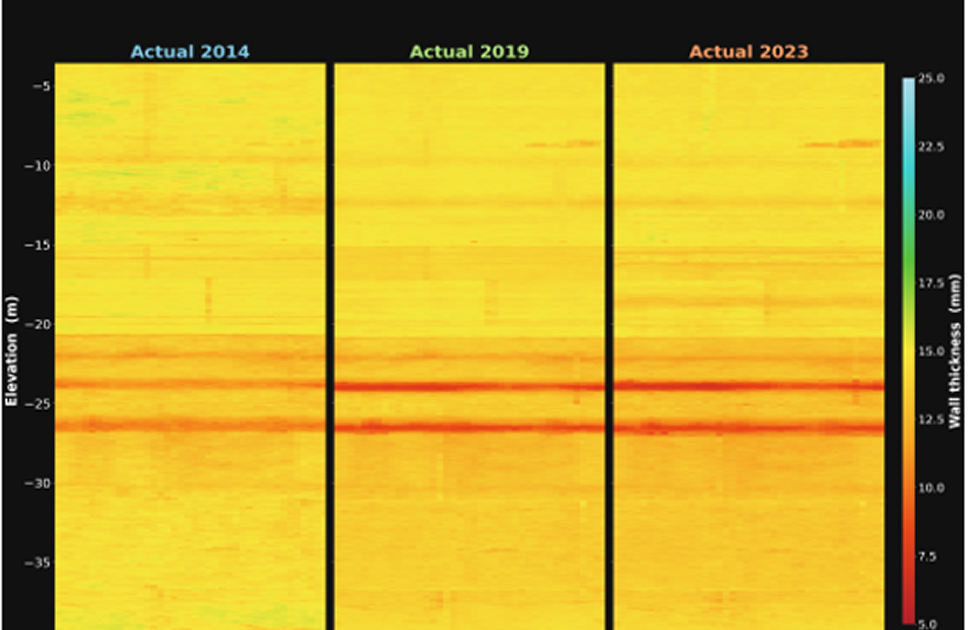
- Mitigating Critical Failure: Through comprehensive data coverage, highly objective AI anomaly detection, and accurate blister height wall-loss estimations, Abyss Fabric demonstrably reduces the severe risk of Loss of Primary Containment (LOPC) by up to 35%, and the overall risk of sudden structural failures caused by external damage by a staggering 95%.
Conclusion
As the highly complex asset integrity industry advances rapidly through 2026, the archaic era of highly subjective, deeply manual, and incredibly hazardous general visual inspections is drawing to a close. The relentlessly compounding pressures of aging infrastructure, legally binding decarbonization mandates, and the catastrophic financial risks associated with unplanned downtime demand a significantly more sophisticated approach to maintenance.
Abyss Solutions has proven that the deep integration of data capture, digital twins, and advanced machine learning analytics is fully operational enterprise reality. By continuously providing objective intelligence that spans, Abyss Solutions is fundamentally and permanently redefining the global standard for industrial safety and mechanical reliability in the AI era.

There are no comments yet!